General
- 28 April 2004
|
|
|
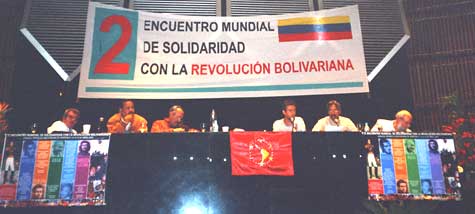
Amongst the international visitors present there were a few representatives of the international Marxist tendency, Alan Woods, editor of In Defence of Marxism, Manzoor Ahmed, the Pakistani Marxist MP, and Miriam Municio, general secretary of the Spanish Students Union. All these comrades explained clearly in a number of public meetings, TV and radio interviews and in discussions with revolutionary activists, that the only way forward for the Venezuela revolution is to advance towards socialism. This would be the best way to deepen and defend the revolutionary process, which the country is going through. The comrades argued for the need to nationalise the banks and monopoly companies under workers control, the need to put the oil company and other state owned companies under workers' control and management, and the need to form workers and peoples' militias in order to defend the revolution against the attacks of the oligarchy and a possible intervention by imperialism.
These ideas were extremely well received by the hundreds of revolutionary activists who listened to them. In a sense it was as if this was exactly what they wanted to hear but, until now, no one had openly defended these ideas in front of an audience like that.
On Wednesday, April 14th, Alan Woods spoke in one of the panels of the meeting together with well known left wing MP Luís Tascón and William Izarra. One hundred people gathered to hear the debate. Alan's intervention was enthusiastically received by the audience.
That same night Manzoor Ahmed was scheduled to speak at one of the main discussions together with Rodolfo Sanz (the main ideologist of the PPT), Heinz Dieterich and others. Manzoor's intervention (straight after a 33 hour journey from Pakistan) electrified the audience. He centred his speech on the lessons of the Pakistani revolution in 1968/69, and how the Pakistan People's Party was founded at that time on the basis of an anti-imperialist, anti-feudal and anti-capitalist programme. Zulfiqar Ali Bhutto came to power as a result of that revolution and he introduced a programme of wide ranging reforms. But, Manzoor warned, because he did not carry out the revolution to the end, finally Martial Law was imposed and Bhutto himself was hanged by the Army. He read from a letter that Bhutto wrote from jail in which he explained how his fate was to a large extent his own fault for having tried to reconcile between irreconcilable class interests and how he was sure of the ultimate victory of the proletariat. The lessons for the revolution in Venezuela were clear for all to see. He finished his speech by saying, "Long live the Venezuelan Socialist Revolution! Long live the World Proletarian Revolution!" which was received with a standing ovation by the whole audience.
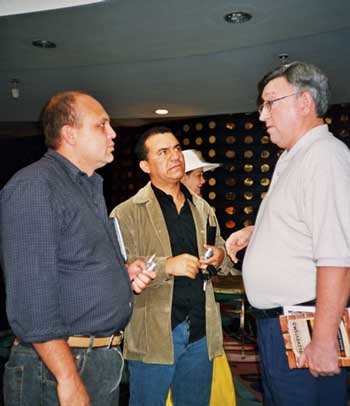
On Friday Alan Woods spoke at a meeting called by TRABUCO, a Bolivarian organisation set up by workers of the Ministry of Science and Technology, in front of an audience of 100 people. Again when he spoke of the need to arm the workers and the people and to nationalise the economy, the audience broke into applause. On Saturday Alan spoke in the revolutionary neighbourhood of El Valle in a meeting called by the Revolutionary Marxist Current (El Topo Obrero – El Militante) which had the support of the local revolutionary radio station Ali Primera. The subject was the role of the Marxists in the revolutionary process, 40 people gathered and there was a lively debate. In the afternoon Alan had been invited to speak at a meeting of community leaders from the working class and poor neighbourhoods in Caracas, in the presidential Palace. The subject of the meeting was "The role of the party in the Revolution" and more than 70 activists turned up.
 |
|
On Monday 19th Alan Woods spoke at a meeting in Barquisimeto, Lara, again on the subject of the role of the Marxists in the revolution. Despite being a national holiday (Independence Day), 80 trade union and neighbourhood activists and leaders gathered in the headquarters of the Social Security Workers Union to hear the speech and the debate.
Miriam Municio also spoke at a number of meetings for youth and student activists in Yaracuy, Barquisimeto, the Pedagogic University in Caracas, the Venezuela Central University and the Bolivarian University, amongst others.
The general feature of all the meetings was the extreme interest in the ideas of Marxism. The comrades from the Revolutionary Marxist Current had organised bookstalls at all meetings and dozens of names were collected of people interested in knowing more about Marxism and becoming active. This is really striking since no other organisation, apart from the CMR, is putting forward the perspective of socialism as the only way forward for the revolution in Venezuela. However it was abundantly clear that this was precisely what many had been waiting to hear, and that the revolutionary situation the country is going through means that these ideas coincide with the practical experience of the advanced layers of worker activists who are groping towards them.
The task of uniting these activists into a national Marxist cadre organisation which could give the process a conscious leadership which would guarantee victory is urgent and necessary. These meetings and discussions proved that the ground is extremely fertile.
- 06 December 2004
World Forum of Intellectuals and Artists in Venezuela Ends with Pledge of Permanent Anti-Globalization Office in Venezuela
By: Robin Nieto - Venezuelanalysis.com
Caracas, December 6, 2004--The World Forum of Intellectuals and Artists in Defense of Humanity closed yesterday with words from Argentine Nobel peace prize laureate, Adolfo Perez Esquivel and President Hugo Chavez and a concert that included Cuban music legend, Pablo Milanes.
President Chavez pledged to provide an office and resources in Venezuela to initiate a "network of networks" of social organizations and institutions around the world working to build alternative models of development in the face in globalization.
Chavez made the announcement at last night's event, which took place in downtown Caracas, was free of charge, and attended by the approximately 350 intellectuals and artists, Venezuelan government cabinet members, and over two thousand spectators.
Adolfo Perez Esquivel, Nobel peace prize winner for his work in raising the issue of human rights violations in Latin America, read the final conclusions of the forum, entitled "The Caracas Declaration." The declaration outlines the need to build a front of global resistance against the project of domination that today is imposed by the current government of the United States of America and global organizations like the World Trade Organization (WTO) and the International Monetary Fund (IMF).
"Let's get to work intensely," Chavez said. "Let's put the ideas concluded at this forum to work, let's make it a reality."
The office for the network of networks is be started in 2005 in Venezuela that will connect the five continents of the world, America, Europe, Asia, Africa and Oceania, and will include the widest possible participation. "Let' s take this network everywhere we go, in the valleys, the mountains, the barrios, the workplace, the study halls, the military barracks and extend this network across the planet Earth," said Chavez.
Chavez noted the need to study the original principles of socialism as well as its errors. The President of the one of the world's largest exporters of oil referred to the importance of early 20th Century Russian revolutionary Leon Trotsky's ideas, embodied in "The Permanent Revolution" and how it explains that there are no national solutions to global problems, referring to the need for a global effort to deal with today's challenges.
Chavez warmly greeted the families of "the Cuban Five," referring to five Cuban men imprisoned in the United States, accused of espionage for their role in participating in anti-terrorism monitoring of extreme right-wing groups in Miami. The five are currently serving life sentences in the U.S. and families are touring the country as part of an international campaign to free their relatives (www.freethefive.org).
President Chavez also announced the inauguration today of the Bolivarian Peoples Congress, which coincides with Chavez's first electoral victory of December 6, 1998, when he won the presidency of Venezuela. "This was the day that opened this path, thanks to the consciousness of the people," Chavez said.
- 03 December 2004
One of the participants at this meeting was José Augustin Guevara, another brother of the two Guevara brothers who have already been arrested in connection with the case. The other Guevara family member to have been arrested, Juan Bautista Guevara, is a cousin of the three brothers and is suspected of having planted the bomb on Danilo Anderson's car. Eyewitnesses place him at the scene shortly before Anderson's car exploded.
José Guevara, the eldest of the three Guevara brothers, has been living in Miami since 2001, when he was detained by the FBI in connection with the search for Peru's fleeing spy chief, Vladimiro Montesinos. The FBI had detained him for attempting to withdraw money from one of Montesinos' bank accounts. It is said that the Guevara brothers were paid $1 million for hiding Montesinos in Venezuela, while he was on the run from Peruvian justice, where he was wanted in connection with corruption and human rights abuses.
José Guevara was released by the FBI shortly after his detention and has ever since been in under FBI protection as a witness.
Attorney General's Office to take over investigation from the police
Venezuela's Attorney General's Office has removed the investigation of the Anderson murder from the country's investigative police because of irregularities that have occurred during the investigation. The investigation will now be conducted by the same team that is investigating the April 2002 coup attempt.One of the reasons for the move is that investigators from the Attorney General's office have raised concerns that the investigative police, the CICPC, has been leaking information to suspects, due to some officer's close ties to the Guevara brothers, who once were members of the investigative police themselves.
Also, a number of irregularities have occurred during the investigation, so that several searches and raids were conducted without the presence of officials from the Public Ministry, as is required by law.
A recent raid on Caracas' Jewish school (Club Hebraica) raised eyebrows and outrage among many Venezuelans and especially the opposition because it is a school for children and any connection with the Anderson case seemed remote at best. Later, though, investigators said that they searched the school because a suspicion had been raised that weapons that were stored at a shooting club, Club Magnum, had been transported and hidden at the school. The police, however, did not find anything at the school. Another reason the incident caused consternation is that at this raid too no representative of the Public Ministry was present.
The investigation will be supplemented by other CICPC officers from the homicide division, who do not have any personal relationship with the arrested Guevara brothers.
Based on information from Últimas Noticias and El Mundo.
- 03 December 2004
Then came the assassination of Danilo Anderson. The 38-year old State Prosecutor was blown up in his car by two attached bombs with remote control detonation, after attending a graduate class at the Bolivarian University. Two suspects in the murder were killed in shoot-outs with police during the following week, and two others have been arrested.
Danilo Anderson was leading the case against the "golpistas" (the coup-plotters who had orchestrated the kidnapping of Chávez and the overthrow of his democratic government in April 2002) and was only days away from formally presenting his case, having just issued over 400 subpoenas.
No-one has gone to jail for the coup, although the signing-in book for dictator-for-a-day Pedro Carmona's inauguration reads like a Who's Who of the Venezuelan oligarchy. The Supreme Court ruled that there was not enough evidence that a coup had taken place; rather there had been a "power vacuum" which the top-dog oil-man happened to fill.
However, fascinating proof of how far the coup-conspiracy stretched has emerged from Chávez' recent visit to Spain, where Foreign Minister Miguel Angel Moratinos revealed on state television that the previous Aznar government had actually instructed its ambassador in Venezuela to support the coup.
Also, a top secret CIA document titled "Venezuela: Conditions Ripening for Coup Attempt", was obtained through a Freedom Of Information Act (FOIA) request by Eva Golinger, a New York-based lawyer. The memo was written on April 6th 2002 - just five days before the coup.
The CIA has a long history of sabotage aimed at progressive movements in Latin America, from paramilitary terrorism against the Sandinistas in Nicaragua to the assassination of Allende in Chile. The Chávez government's policies of wealth redistribution and spending oil profits on free healthcare, education and housing makes it a prime target for attack.
Golinger also discovered that, since 2001, the US government has channelled over $20-million to forces fiercely opposed to President Chávez. Three-quarters of it came from the National Endowment for Democracy (NED), a quasi-governmental entity entirely funded by Congress and widely perceived to be a CIA-front.
Danilo Anderson, the murdered prosecutor, was trained to follow the money - in this case, from the United States. Venezuela, like most countries, has strict laws about this: it is illegal for any organisation in Venezuela to take money from a foreign power in order to influence elections. (If this seems overly harsh, consider the outrage if, say, Libya were to start funding the Respect party here!)
One such organisation is Súmate, who spearheaded the August referendum campaign against Chávez, and according to Golinger's FOIA research has received more than $3-million through the NED. Despite claiming the money was used "just for teaching", it is also being charged with creating a parallel electoral council in an attempt to illegally influence the referendum result.
In early November, the president of the NED, Carl Gershman, made an unprecedented visit to Venezuela to defend the company's interests. After being refused an audience with Chávez, Gershman tried to lobby both the Attorney General and the President of the Supreme Court to have the case against Súmate dropped.
One day after he left, empty-handed, a letter was released from 70 "international democrats" (most of whom are financially connected to the NED) demanding a halt to the Súmate trial. In response the Venezuelan Ambassador to Washington, Bernardo Alvarez, called for a formal investigation into the NED's funding and activities in Venezuela.
Gershman's visit wasn't totally in vain. Less than a week later, the Supreme Court ruled that Súmate's directors, María Corina Machado and Ricardo Estévez, should be released on bail because they posed no flight risk (unlike the other rich "golpistas" who'd gone into hiding, most ending up in Miami).
The following day, Danilo Anderson was murdered.
Although some on the right-wing are publicly hinting that Chávez himself was behind the assassination (for the same reason he staged the coup, to crack down on dissent) most eyes are focussing on two places: Colombia and Miami.
It is not long since 130 Colombian paramilitaries, dressed in Venezuelan military uniforms, were arrested on a ranch just outside of Caracas. The Anderson car-bombing is very much in their style, as well as that of the CIA. Coup-leader Carmona sought asylum in the Colombian embassy shortly after he was placed under house-arrest.
But also to consider are the Venezuelan "exiles", undergoing military training in the Florida Everglades with their Cuban counterparts for several years now. Most openly call for the assassination of Chávez, and earlier this year General Felipe Rodriguez declared from Miami that he was commencing a clandestine guerrilla civil war.
The US has been asked by Venezuela repeatedly for their help in capturing and extraditing these would-be terrorists, but Washington's only public comment has been that it's "not necessarily a crime" for terrorists to train on US soil - as long as their terror isn't directed against the US.
Terror directed by the US is another matter. After the Spanish revelations, the Bush administration claimed they had indeed "alerted President Chávez to coup plots" - presumably their own! If this attack is a taste of their second term priorities, at least it shows how desperate they're getting.
As always, the ultra-right will end up shooting themselves in the foot, and this unprecedented act of aggression will only serve to radicalise the progressive government, unite a class war-weary country and earn Venezuela sympathy, support and solidarity around the world.
As John McDonnell MP wrote on November 23rd in Early Day Motion 127, the car-bombing "is a further attempt to destabilise the country by those ... who refuse to respect the will of the Venezuelan people". Find out if your MP has signed this EDM at http://edmi.parliament.uk/EDMi/EDMDetails.aspx?EDMID=126 and put pressure on them if they haven't!
The UK Bolivarian Circle and Hands Off Venezuela (London) will be having a candlelit vigil outside the Venezuelan consulate, Grafton Way, W1 (off Tottenham Court Road, nearest tube Warren Street) on Thursday December 2nd from 6pm. This will be two weeks after the assassination of Danilo Anderson and we invite anyone who cares about Venezuela, of whatever political stripe, to join us in condemning this barbaric and cowardly act of intimidation. Please wear black.
- 01 December 2004
Washington opposes Venezuela arms build-up
By James Harding in Ottawa and Andy Webb-Vidal in Bogotá
The Bush administration on Tuesday made plain its opposition to Hugo Chávez's arms procurement programme, in particular the Venezuelan president's plans to buy Russian fighter jets.
“Let me put it this way: we shoot down Migs,” a senior administration official said when asked whether the intended purchase concerned the US government.
The forthright remark was quickly clarified by Sean McCormack, the National Security Council spokesman at the White House, who said the comment simply reflected the fact that Venezuela's arms build-up “is clearly an issue that we monitor closely”.
But the unequivocal criticism of Venezuela's arms purchases underscores Washington's hostility towards the Chávez government and concern that Russia is arming a country viewed by the US as a destabilising force in the region.
At the end of a visit to Moscow last weekend, Mr Chávez said his government would take delivery of 40 helicopters from Russia and he had agreed to buy 100,000 semi-automatic rifles. The move is expected to be followed by Venezuela's acquisition of the most advanced model of the Mig-29 fighter jet.
Reports in recent weeks suggest Mr Chávez wants as many as 50. The senior Bush administration official, who was briefing on President George W. Bush's meetings with Paul Martin, Canada's prime minister, answered a question about whether the US was concerned about Venezuelan arms purchases by saying: “It should be an issue of concern to the Venezuelan people. Millions of dollars are going to be spent on Russian weapons for ill-defined purposes.”
Anxieties have already been voiced in Colombia about the arms build-up in neighbouring Venezuela, a concern to the rightwing government of President Alvaro Uribe as it seeks to defeat the insurgent army of the Revolutionary Armed Forces of Colombia (FARC).
The US strongly supports the Colombian army. Mr Chávez, a left-leaning former army officer whose government has faced strong opposition for much of the past six years, has said the new armaments are defensive: “Venezuela is not going to attack anyone.” Mr Chávez has opposed the US since being briefly unseated in a coup in 2002 which he insists was planned by the Bush government. The prospective Mig purchase comes at a testing time for Washington-Moscow relations. Mr Bush has grown alarmed at the apparent deterioration of democracy in Vladimir Putin's Russia and finds himself on the opposite side to the Russian president over the disputed Ukraine elections.
Join / affiliate to the campaign!
 Please help build the campaign by joining as an individual or affiliating your trade union
Make a donation!
Hands Off Venezuela's financial resources are limited so we rely on our supporters around the world. Please make a donation of any size towards building the campaign