General
- 10 June 2005
For the last four weeks, Bolivian workers and peasants have been
mobilising demanding the nationalisation of the country's oil and gas
reserves. This movement represents the will of the majority of
Bolivians to win control over their natural resources. The oil and gas
multinationals have been benefiting from the country’s natural
resources through illegal contracts for years, while the majority of
Bolivians live under the poverty line.
Far from being a “radical minority” as president Mesa said, those who
demand nationalisation of gas are the majority, as was shown by the
open mass meeting that took place on June 6th in La Paz, with half a
million people present, and the continued strength of the general
strike, road blockades, mass marches and demonstrations.
We wholeheartedly support the legitimate demands of Bolivian workers
and peasants and give support to their movement and organisations and
the decisions they take about how to conduct their struggle.
We reject any attempt of the government or sections of parliament to
impose a military solution or the use of repression to put an end to
the protests. We also reject the attempts of the so-called “Civic
Committees” in Santa Cruz and other regions to use paramilitary gangs
against the peasant mobilisation.
We reject any foreign intervention. The solution to the problems facing
the Bolivian people must be in the hands of the people themselves,
without any interference from the Organisation of American States, the
United States, etc.
We appeal to the labour and trade union movement worldwide and to all
progressive people to show solidarity with the Bolivian workers and
peasants in these crucial moments, send solidarity resolutions, pass
motions, organise pickets of the embassies and oil multinationals, and
in general support our Bolivian brothers and sisters.
Further details from
Bolivia Solidarity Campaign
53 Fladgate Road
London
E11 1LX
- 06 June 2005
Ft. Lauderdale, FL, June 5, 2005—The representative of the host state, US Secretary of State Condoleezza Rice, spoke at the 35th General Assembly of the OAS this Sunday night.
Referring to Secretary General Insulza, Rice said she and US President George W. Bush looked forward to working with Insulza towards making the OAS a “very effective organization for the promotion of democracy and prosperity in our hemisphere.”
Rice cast the US conflict with Venezuela as a divide between “nations that promote democracy, good governance and free trade, and those that do not. Washington is eager to have good relations with all nations…provided that they agree on those core concepts.” Her paring of democracy with free-markets provides a particular contrast to Venezuela, given that perhaps the most fundamental conflict between the US and Venezuela is over the neoliberal model.
"The last time the OAS met in the US in 1974," noted Rice, "10 of 23 members were dictators." "For seven days leaders of non-democratic countries waxed hypocritically on the ideals of 'democracy,'" she said, criticizing the 'old OAS' for being “long on talk and short on action.”
At the time, many of the military dictators Rice referred to were the US government’s closest allies in the region. The meeting in 1976, when the OAS held its 5th General Assembly in Santiago, Chile, was home of the US-supported Chilean dictator Augusto Pinochet.
Rice also reiterated a now common statement, generally understood as a reference to Venezuela, saying, “Governments that are elected democratically, must govern democratically. And as Secretary-General Insulza has rightly declared: governments that fail to reach this crucial standard must be accountable to the OAS.” When Insulza made this statement, it was, according to an aide to Secretary Rice, insisted upon word-for-word by Secretary Rice as the condition for US support for Insulza’s leadership bid at the OAS.
"We at the OAS must be impatient, we must replace excessive talk with action,” said Rice. “We must never accept that democracy is merely an ideal to be admired instead of a purpose to be realized.”
OAS Interventionism
In a press briefing given on the plane to Florida this morning, Secretary Rice did not mince words on what she sees as the necessary teeth the OAS must develop. Rice responded to a question regarding the adverse reaction of a number of Latin American ambassadors to US proposals to create a mechanism for OAS intervention, saying “let me say again the OAS has intervened in the past…this is not a matter of intervening to punish; it is a matter of intervening to try and sustain the development of democratic institutions across the region.”
For his part, Venezuelan President Hugo Chávez said “if any member-government of the OAS should be monitored, it’s the government of the United States.” “A government that supports terrorists, invades countries, that tramples its own people, that is trying to impose a global dictatorship,” said the Venezuelan President, “is the government that should be monitored for human rights violations.”
- 06 June 2005
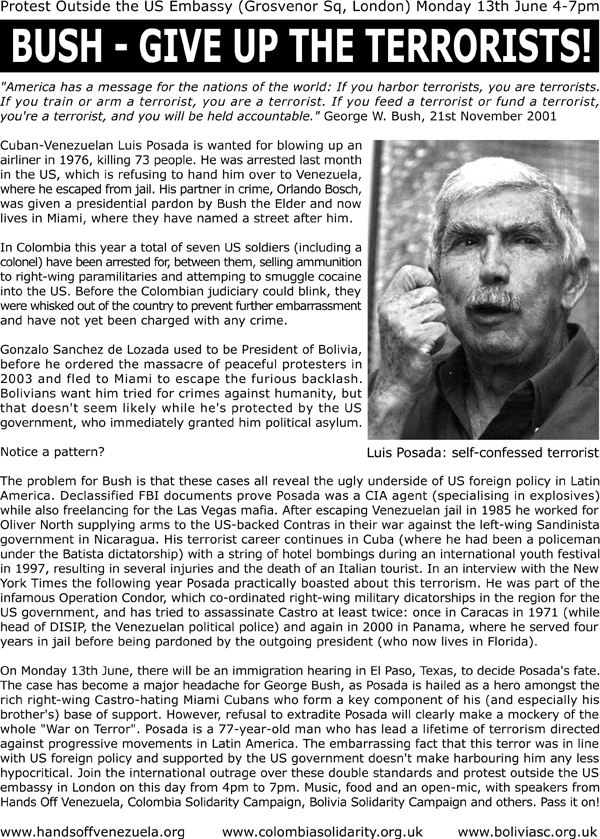
Protest Outside the US Embassy (Grosvenor Sq, London) Monday 13th June 4-7pm
BUSH - GIVE UP THE TERRORISTS!
"America has a message for the nations of the world: If you harbor terrorists, you are terrorists. If you train or arm a terrorist, you are a terrorist. If you feed a terrorist or fund a terrorist, you're a terrorist, and you will be held accountable." George W. Bush, 21st November 2001
Cuban-Venezuelan Luis Posada is wanted for blowing up an airliner in
1976, killing 73 people. He was arrested last month in the US, which
is refusing to hand him over to Venezuela, where he escaped from jail.
His partner in crime, Orlando Bosch, was given a presidential pardon
by Bush the Elder and now lives in Miami, where they have named a
street after him.
In Colombia this year a total of seven US soldiers (including a
colonel) have been arrested for, between them, selling ammunition to
right-wing paramilitaries and attempting to smuggle cocaine into the
US. Before the Colombian judiciary could blink, they were whisked out
of the country to prevent further embarrassment and have not yet been
charged with any crime.
Gonzalo Sanchez de Lozada used to be President of Bolivia, before he
ordered the massacre of peaceful protesters in 2003 and fled to Miami
to escape the furious backlash. Bolivians want him tried for crimes
against humanity, but that doesn't seem likely while he's protected by
the US government, who immediately granted him political asylum.
Notice a pattern?
The problem for Bush is that these cases all reveal the ugly underside
of US foreign policy in Latin America. Declassified FBI documents
prove Posada was a CIA agent (specialising in explosives) while also
freelancing for the Las Vegas mafia. After escaping Venezuelan jail in
1985 he worked for Oliver North supplying arms to the US-backed
Contras in their war against the left-wing Sandinista government in
Nicaragua. His terrorist career continues in Cuba (where he had been a
policeman under the Batista dictatorship) with a string of hotel
bombings during an international youth festival in 1997, resulting in
several injuries and the death of an Italian tourist. In an interview
with the New York Times the following year Posada practically boasted
about this terrorism. He was part of the infamous Operation Condor,
which co-ordinated right-wing military dicatorships in the region for
the US government, and has tried to assassinate Castro at least twice:
once in Caracas in 1971 (while head of DISIP, the Venezuelan political
police) and again in 2000 in Panama, where he served four years in
jail before being pardoned by the outgoing president (who now lives in
Florida).
On Monday 13th June, there will be an immigration hearing in El Paso,
Texas, to decide Posada's fate. The case has become a major headache
for George Bush, as Posada is hailed as a hero amongst the rich
right-wing Castro-hating Miami Cubans who form a key component of his
(and especially his brother's) base of support. However, refusal to
extradite Posada will clearly make a mockery of the whole "War on
Terror". Posada is a 77-year-old man who has lead a lifetime of
terrorism directed against progressive movements in Latin America. The
embarrassing fact that this terror was in line with US foreign policy
and supported by the US government doesn't make harbouring him any
less hypocritical. Join the international outrage over these
double-standards and protest outside the US embassy in London on this
day from 4pm to 7pm. Music, food and an open-mic, with speakers from
Hands Off Venezuela, Bolivia Solidarity Campaign, Colombia Solidarity
Campaign and others. Pass it on!
www.handsoffvenezuela.org
www.colombiasolidarity.org.uk
www.boliviasc.org.uk
- 24 May 2005
If Washington refuses to extradite Cuban terrorist Luis Posada Carriles Venezuela could severe diplomatic ties between the two nations, said Venezuelan President Hugo Chávez yesterday. “We can't rush things, but if the United States does not extradite [Posada] we will be forced to reconsider our diplomatic ties,” affirmed Chávez during his weekly Sunday television address Aló Presidente.
Last week Caracas invoked a 1922 US-Venezuela extradition treaty to request that the US deport Posada—who has dual Cuban-Venezuelan citizenship—to Venezuela to stand trial for masterminding the 1976 bombing of a civilian Cuban airliner that killed all 73 people on board.
 |
| Venezuelan President Hugo Chavez shows the audience documented evidence of Posada's terrorist activities and of the CIA's knowledge during last Sunday's "Alo Presidente." |
Although Posada, a former CIA agent, illegally entered the US through the Mexican border in mid-March, US officials repeatedly denied that they were able to verify his whereabouts. But Posada, a self-described “freedom fighter,” forced Washington's hand last week by holding a press conference outside Miami. Shortly after Posada affirmed that he would "not denounce violence," he was arrested by US immigration officials. Facing charges of illegal entry rather than terrorism, Posada is being detained in a federal detention center in El Paso, Texas without bail until his June 13th trial.
“If they don't extradite him in the time allowed in our agreement,” warned Chávez, “we will have to consider whether it's worth having an embassy there, and whether it's worth the United States having an embassy here.”
Until Chávez came to power in 1998, Venezuela and the US had a cozy relationship. Posada and the CIA cooperated regularly in the oil-rich nation until Posada’s arrest in 1976 for the airplane bombing. After he escaped from a Venezuelan prison in 1985, Posada surfaced in Central America where he worked with Oliver North’s illegal mission to supply the Contras with weapons in Nicaragua’s US-fueled civil war.
But with Chávez’s election, US-Venezuelan relations have gone from close to hostile. The Venezuelan government has aggressively pursued a path of sovereignty and social justice, fiercely attacking what Chávez describes as the US’ economic and political exploitation of Latin American countries. For their part, the Bush administration refers to Chávez as a "negative force in the region" and a "democratically elected leader who governs in an illiberal way,”—just a few of the more vaguely-worded, recycled "concerns" about Chávez emitted by US spokespeople on an almost daily basis.
Chávez' statements on Sunday eluded that already poor bilateral relations might very well take a sharp turn for the worse if Washington decides to blatantly and hypocritically ignore its own "war on terror" rhetoric. After emphasizing that "now there is proof that the US protects terrorism because in there territory is one of the greatest terrorists in the history of America and of the world," Chávez put the option of taking the dispute to an international tribunal on the table.
 |
| Luis Posada Carriles is wanted in Venezuela and Cuba for his involvement in a 1976 bombing that killed 73. The US has so far refused Venezuela's extradition request. |
"We have sufficient material to go to an international tribunal and accuse the US government of protecting a terrorist; we will go to the United Nations, we will invite all of the people to denounce this,” said Chávez. “[This is] a government that invades a country using terrorism as an excuse, that attacks Iraq only to take out one man in that government…now they have him in prison and they publish a photo of him in his underwear. At the US Army prison in Guantanamo Bay, “they have been so disrespectful to the Koran that they have provoked a dignified response from the Islamic people of the world," added the Venezuelan President.
Chávez went on to add that the Venezuelan government has evidence that Posada, along with his contacts in Venezuela and Central America, "participated in preparations for the April, 2002 coup" that abolished all democratic institutions in Venezuela before being reversed 48 hours later.
“It is difficult, very difficult, to maintain ties with a government that so shamelessly hides and protects international terrorism,” said Chávez.
The decision to charge Posada with illegal entry and ignore his resume of terrorist activities has enraged the majority of Venezuelans. Thousands of Venezuelans signed a petition in favor of the extradition request on Friday and then marched on Saturday in the squares of major cities in protest.
This observation has also been noted by several US politicians.
"While I'm glad that the Department of Homeland Security finally arrested Posada, it's amazing that he almost had to goad them into doing it," stated José Serrano (D-NY) adding that, "Here is a guy who has admitted to committing terrorist attacks who escaped justice by bribing his guards and hightailing it out of prison, and we're not willing to extradite him to face justice. 73 people died in that airliner, many of them children. How can we with any credibility ask other nations to help us out with our global struggle against terror when we won't cooperate with others' anti-terror proceedings? There is a two-way street here…Posada was a wanted man in Venezuela long before Hugo Chávez was elected President there.”
Dennis Kucinich (D-OH) and a group of twenty legislators sent a letter to President Bush recommending that international laws be followed and Posada be turned over to Venezuela. And in a letter to the US Congress, Cynthia McKinney (D-GA) called upon her colleagues to "uphold the principles we espouse, refrain from keeping double standards," and "extradite [Posada] to the governments with jurisdiction." McKinney argued that "for the Department of Homeland Security to say it would not deport Posada to Cuba or Venezuela is counterproductive to our efforts in the War on Terror."
- 26 May 2005
 |
| According to PdVSA president Ramírez, 90% of the transnationals participating in operating agreements, have committed tax evasion, cheating the Venezuelan state out of $3 billion in taxes and $1 billion in royalties. Credit: Agencia Bolivariana de Noticias (ABN |
Venezuela’s Minister of Energy and Mines, Rafael Ramírez, appeared before the Venezuelan National Assembly today in order to expose the abuses committed by transnational corporations in Venezuela's oil sector and to inform the Venezuelan people that with the opening of the petroleum industry to foreign companies, during the 1990’s, "a true assault was carried out against Venezuelan petroleum."
Ramírez explained that over the course of the past decade and a half, foreign investment amounted to an assault "coordinated by international institutions of oil consuming nations and the large transnationals, who in complicity of the oligarchy and their political representatives conspired against the Venezuelan state, causing their subsequent economic and social crisis."
Ramírez, who is also the President of Venezuela's state owned petroleum company, PdVSA, offered his testimony before a Special Commission that has been formed to investigate the irregularities detected by the Ministry of Energy and Petroleum in the drawing up and the execution of service agreements. These service agreements, signed between the former management of PdVSA and transnational oil companies, such as Chevron Texaco, Royal Dutch Shell, Total, and Repsol, were signed between 1992 and 1997, the years of years of the so-called "petroleum opening."
Currently transnational oil companies produce about 500,000 barrels of oil per day (bpd) via these service agreements and another 600,000 bpd of extra-heavy oil as part of joint ventures with PdVSA, in the Orinoco Oil Belt. According to the Ministry of Energy and Mines, PdVSA produces the remaining 2 million bpd, for a Venezuelan total of about 3.2 million bpd. However, analysts opposed to the government and its oil policy, contend that PdVSA produces only 1.4 million bpd or 600,000 less than the government claims.
In the course of renegotiating the 32 service agreements, it has come to light that, according to Ramírez, 90% of the transnationals have committed tax evasion, cheating the Venezuelan state out of $3 billion in taxes and $1 billion in royalties. “Some of these companies haven't paid taxes for years,” said Ramirez, adding, “They are mocking our laws. This is an unacceptable situation. We can't permit this.”
“As we will see, this is not about isolated or fortuitous incidents,” Ramírez assured, affirming that on the contrary, “this is a strategy that unfolded since the nationalization of PdVSA in 1976 and is oriented towards taking control over PdVSA for transnational interests.” Ramirez summarized the essence of the "well planned and designed," petroleum opening as a "Trojan Horse."
In October of last year, the Chavez government announced that transnational oil companies that had service agreements with PdVSA that were signed in the 1990’s, must now be converted into joint ventures, in which foreign companies are limited to a 49% stake in any project, reserving the majority share for PdVSA. Also, in April of this year, the Venezuelan government raised the royalties that companies in the Orinoco Oil Belt must pay, from 1% to 16%. So far all oil companies operating in Venezuela, except for ExxonMobil, have accepted the new terms.
Ramírez asserted that "with the petroleum opening, the transnational capital tried to expropriate the handling and the sovereign use of our main natural resource: petroleum," converting it from a natural resource of the Venezuelan state into a natural resource at the disposal of the consumer countries of the world.
According to the PdVSA president, the collapse of Venezuela’s oil revenue in the 1990’s is attributable to earlier government efforts to sweep away state control over the oil industry. “They were prepared to turn over our energy resources to transnational capital and to yield it to privatization and those who wanted to impose their version of globalization on Venezuela,” he said.
New attacks
In reference to the recent opposition media’s reporting of supposed problems in the oil industry, Ramírez testified that Venezuela's oil industry is now being attacked by the same people who initiated the economic sabotage of December 2002 to February 2003, which effectively shutdown the oil industry for that time and caused losses of over $14 billion. Ramirez said that the former oil industry managers are resisting the control Venezuela’s government is exerting over its own industry by engaging in a disinformation campaign.
Ramírez requested that an investigation be carried out in order to determine who is responsible for undermining PdVSA's independence and recommended that the National Assembly adopt a firm and united position with respect to the scandal.
“The game is over with the 32 contracts and now the truth will be made known," said Ramirez. He left the revising of the 32 service agreements and the actions of the transnational companies in the hands of the National Assembly, stating that "this is an affair that the National Assembly must rule on and propose pertinent actions to take." He also recommended that other state entities such as the Central Bank of Venezuela (BCV) and Venezuela's tax agency Seniat should be involved in the evaluation. According to Ramirez, half of the 32 service agreements are money losing ventures for Venezuela, where PdVSA pays more to transnationals for oil production than it can recoup from the sales of that oil.
Ramirez also highlighted irregularities in the extra-heavy oil production joint ventures, saying that Sincor, which is a joint venture with France’s Total, has violated its contract repeatedly, exploiting a far larger area than it is supposed to. Currently there are five extra-heavy oil joint ventures, about which Ramirez said, “We have found irregularities in all.” The other four companies involved in the joint ventures are Exxon Mobil Corp., Chevron, British Petroleum, and ConocoPhillips.
Ramirez also pointed out that Citgo Corp, the subsidiary of PdVSA operating in the United States, had overpaid taxes in that country, and that PdVSA would work to recuperate these taxes in accordance with the U.S.-Venezuelan Double Taxation Treaty.
Join / affiliate to the campaign!
 Please help build the campaign by joining as an individual or affiliating your trade union
Make a donation!
Hands Off Venezuela's financial resources are limited so we rely on our supporters around the world. Please make a donation of any size towards building the campaign